
Fathers carrying collective on tap: A community-based feasibility study of babywearing for fathers at local breweries
-
2026
Journal articles
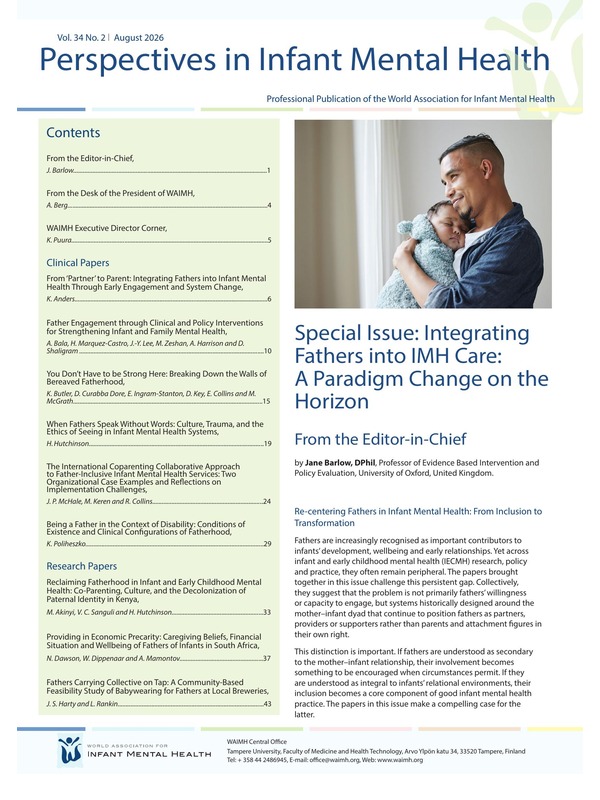
Harty, J. S., & Rankin, L. Fathers carrying collective on tap: A community-based feasibility study of babywearing for fathers at local breweries. Perspectives in Infant Mental Health, 34(2).
@article{zotero-item-9543,
  title = {Fathers Carrying Collective on Tap: {A} Community-Based Feasibility Study of Babywearing for Fathers at Local Breweries},
  author = {Harty, Justin S.} and Rankin, Lela},
  date = {2026},
  journaltitle = {Perspectives in Infant Mental Health},
  shortjournal = {Perspect. Infant Ment. Health},
  volume = {34},
  number = {2},
  url = {https://perspectives.waimh.org/wp-content/uploads/sites/9/2026/09/2026_2_perspectives_imh_published_22_9_2026.pdf},
}
Abstract
Fathers play a critical role in infant development, yet they remain systematically excluded from the medical, social service, and early intervention systems designed to support caregiving in the #rst year of life. Babywearing, the practice of carrying an infant in a cloth carrier worn on the body, is an evidence-informed caregiving practice studied almost exclusively with mothers. The Fathers Carrying Collective on Tap (FCCT) is a community-embedded babywearing intervention designed speci#cally for fathers and delivered at local breweries. This feasibility study examined whether fathers would enroll, engage, and sustain participation across two father- centered events in Arizona in Spring 2026. Feasibility indicators included recruitment yield, event attendance, weekly survey response rates, retention, engagement, and participant-reported satisfaction. Thirteen fathers enrolled at the Tucson event; the Phoenix event, launched without embedded community partnerships, yielded no attendees. Weekly follow-up response rates across the #rst four weeks were high (100%, 100%, 85%, 92%), and fathers reported approximately 58 minutes of daily babywearing on average, closely tracking the one-hour target. Satisfaction was uniformly positive. The contrast between sites indicates that established community partnerships, not the venue alone, drive recruitment. Findings support the intervention's feasibility and inform the design of a subsequent e!cacy-focused trial.