

Publications
Journal articles (29)
-
2026
Journal articles

Harty, J. S., Blackdeer, A. A., & Murray, B. J. Histories shaping social work: A century of historical research in Social Service Review and the next 100 years. Social Service Review, 000–000.
@article{zotero-item-9047, title = {Histories Shaping Social Work: {A} Century of Historical Research in {Social Service Review} and the next 100 Years}, author = {Harty, Justin S.} and Blackdeer, Autumn Asher and Murray, Bethany Jo}, date = {2026}, journaltitle = {Social Service Review}, shortjournal = {Soc. Serv. Rev.}, pages = {000--000}, doi = {10.1086/743563}, } -
2026
Journal articles
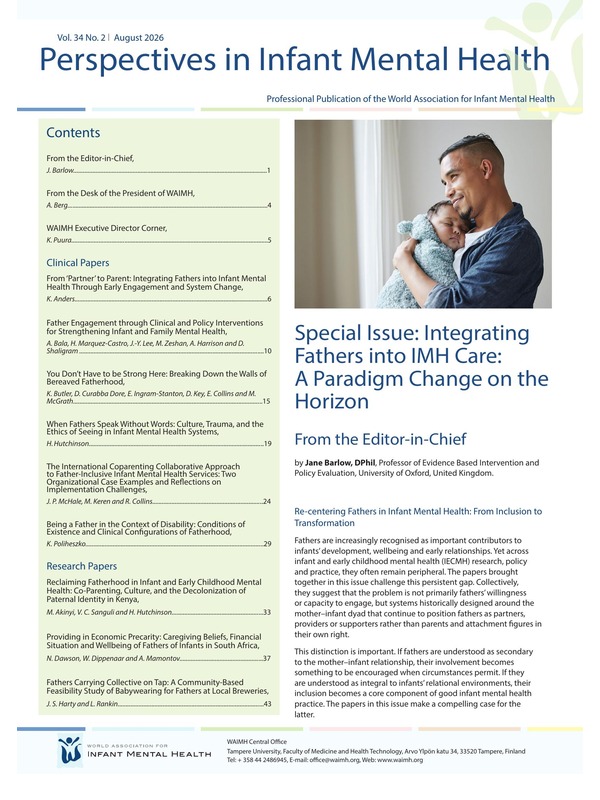
Harty, J. S., & Rankin, L. Fathers carrying collective on tap: A community-based feasibility study of babywearing for fathers at local breweries. Perspectives in Infant Mental Health, 34(2).
Fathers play a critical role in infant development, yet they remain systematically excluded from the medical, social service, and early intervention systems designed to support caregiving in the #rst year of life. Babywearing, the practice of carrying an infant in a cloth carrier worn on the body, is an evidence-informed caregiving practice studied almost exclusively with mothers. The Fathers Carrying Collective on Tap (FCCT) is a community-embedded babywearing intervention designed speci#cally for fathers and delivered at local breweries. This feasibility study examined whether fathers would enroll, engage, and sustain participation across two father- centered events in Arizona in Spring 2026. Feasibility indicators included recruitment yield, event attendance, weekly survey response rates, retention, engagement, and participant-reported satisfaction. Thirteen fathers enrolled at the Tucson event; the Phoenix event, launched without embedded community partnerships, yielded no attendees. Weekly follow-up response rates across the #rst four weeks were high (100%, 100%, 85%, 92%), and fathers reported approximately 58 minutes of daily babywearing on average, closely tracking the one-hour target. Satisfaction was uniformly positive. The contrast between sites indicates that established community partnerships, not the venue alone, drive recruitment. Findings support the intervention's feasibility and inform the design of a subsequent e!cacy-focused trial.
@article{zotero-item-9543, title = {Fathers Carrying Collective on Tap: {A} Community-Based Feasibility Study of Babywearing for Fathers at Local Breweries}, author = {Harty, Justin S.} and Rankin, Lela}, date = {2026}, journaltitle = {Perspectives in Infant Mental Health}, shortjournal = {Perspect. Infant Ment. Health}, volume = {34}, number = {2}, url = {https://perspectives.waimh.org/wp-content/uploads/sites/9/2026/09/2026_2_perspectives_imh_published_22_9_2026.pdf}, } -
2026
Journal articles
Katz, C. C., Jackson, S., Dworsky, A., Okpych, N. J., Cheatham, L. P., Harty, J. S., Powers, J., Salazar, A. M., Shpiegel, S., Munson, M. R., Blakeslee, J. E., Geiger, J. M., Havlicek, J., Johnson, R. M., Taussig, H., & Courtney, M. The transition-age youth special interest group: The establishment and activities of a U.S.-based network of child welfare researchers. Families in Society: The Journal of Contemporary Social Services, 107(2), 435–449.
This paper provides an overview of the history and current activities of a group of researchers focused on the experiences of young people who “age out” of foster care in the United States. These transition-age youth (TAY) often have intersecting marginalized identities, as youth of color, queer youth, and youth with disabilities are disproportionately represented in care. Members of the Transition-Age Youth Special Interest Group (TAY-SIG) conduct research in several key domains, many addressing the discrimination, trauma, and poverty experienced by the majority of TAY. We report on the cutting-edge research happening in these areas and highlight the gaps in the research that require urgent attention. Despite these gaps, we argue that research undertaken by TAY-SIG members has driven the field of TAY research forward in a variety of timely and important ways.
@article{katz2026, title = {The Transition-Age Youth Special Interest Group: {The} Establishment and Activities of a {U}.{S}.-Based Network of Child Welfare Researchers}, shorttitle = {The Transition-Age Youth Special Interest Group}, author = {Katz, Colleen C. and Jackson, Sebrena and Dworsky, Amy and Okpych, Nathanael J. and Cheatham, Leah P. and {Harty, Justin S.} and Powers, Jenna and Salazar, Amy M. and Shpiegel, Svetlana and Munson, Michelle R. and Blakeslee, Jennifer E. and Geiger, Jennifer M. and Havlicek, Judy and Johnson, Royel M. and Taussig, Heather and Courtney, Mark}, date = {2026}, journaltitle = {Families in Society: The Journal of Contemporary Social Services}, shortjournal = {Fam. Soc. J. Contemp. Soc. Serv.}, volume = {107}, number = {2}, pages = {435--449}, issn = {1044-3894, 1945-1350}, doi = {10.1177/10443894251316394}, } -
2026
Journal articles
Kwan, J. Y., Park, I. Y., Bellamy, J. L., Banman, A., Harty, J. S., & Guterman, N. B. The longitudinal effect of union and housing instability on low-income fathers’ and mothers’ parenting stress: An exploratory study of variable- and person-centered approaches. Family Transitions, 1–32.
@article{kwan2026, title = {The Longitudinal Effect of Union and Housing Instability on Low-Income Fathers’ and Mothers’ Parenting Stress: An Exploratory Study of Variable- and Person-Centered Approaches}, shorttitle = {The Longitudinal Effect of Union and Housing Instability on Low-Income Fathers’ and Mothers’ Parenting Stress}, author = {Kwan, Jin Yao and Park, In Young and Bellamy, Jennifer L. and Banman, Aaron and {Harty, Justin S.} and Guterman, Neil B.}, date = {2026}, journaltitle = {Family Transitions}, shortjournal = {Fam. Transit.}, pages = {1--32}, issn = {2837-5300, 2837-5319}, doi = {10.1080/28375300.2026.2693826}, } -
2026
Journal articles
Murray, B. J., Harty, J. S., & Dettlaff, A. J. Accountability or complicity? Social work’s dual commitments and crisis of accountability in the US. Critical and Radical Social Work, Preprint, 1–19.
The social work profession in the US espouses commitments to equity and justice while also being complicit in systems of racial and social oppression, revealing a persistent accountability crisis within the profession. This article traces the historical and contemporary dimensions of that crisis, asking: To whom is social work accountable? Through archival research and analysis of contemporary case studies, we trace how professional bodies have defined, regulated, and enforced accountability since the 1970s. We argue that professional regulation, codified during this period, aligned social work with state power by prioritizing risk management and professional legitimacy politics over accountability to marginalized communities. Amid authoritarian resurgence and the suppression of marginalized communities, these alignments demand renewed scrutiny. Using accountability as a central analytic, this article contends that ethical practice in social work requires moving beyond compliance with state regulation and toward collective responsibility to communities.
@article{murray2026, title = {Accountability or Complicity? {Social} Work’s Dual Commitments and Crisis of Accountability in the {US}}, shorttitle = {Accountability or Complicity?}, author = {Murray, Bethany Jo and {Harty, Justin S.} and Dettlaff, Alan J.}, date = {2026}, journaltitle = {Critical and Radical Social Work}, shortjournal = {Crit. Radic. Soc. Work}, volume = {Preprint}, pages = {1--19}, publisher = {Policy Press}, issn = {2049-8608, 2049-8675}, url = {https://bristoluniversitypressdigital.com/view/journals/crsw/aop/article-10.1332-20498608Y2025D000000118/article-10.1332-20498608Y2025D000000118.xml}, } -
2026
Journal articles
Park, S. E., Liu-Raphael, S., Gomez, A., Harty, J. S., & Okpych, N. J. Urbanicity and county-level variation in transitional housing placements for transition-age youth in California foster care. Child Maltreatment.
@article{zotero-item-9049, title = {Urbanicity and County-Level Variation in Transitional Housing Placements for Transition-Age Youth in {California} Foster Care}, author = {Park, Sunggeun Ethan and Liu-Raphael, Selena and Gomez, Anthony and {Harty, Justin S.} and Okpych, Nathanael J.}, date = {2026}, journaltitle = {Child Maltreatment}, shortjournal = {Child Maltreat.}, } -
2026
Journal articles

Thomas, A., Walsh, T., Cryer-Coupet, Q. R., Harty, J. S., & Pate, D. The health implications of fatherhood: A comprehensive literature review. Annual Review of Public Health.
There is growing recognition that paternal involvement matters for child development and family well-being, even while we know comparatively little about how fatherhood affects men's own physical and mental health. This review brings together our current understanding of how becoming and being a father shapes men's health and the current efforts at improving the fatherhood experiences for men, thus indirectly influencing their children and families. We explore emerging work on father support systems, from mobile health interventions to successful community-based programs. The review also considers how policy—both historic and current—has shaped fathers’ health and their capacity to be involved parents. Our analysis reveals substantial gaps, particularly around understanding the nuances of paternal support. We conclude by identifying where research efforts should focus next and what practitioners and policymakers need to consider, as attention to the impact of fatherhood on men's health continues to grow.
@article{thomas2026, title = {The Health Implications of Fatherhood: {A} Comprehensive Literature Review}, shorttitle = {The Health Implications of Fatherhood}, author = {Thomas, Alvin and Walsh, Tova and Cryer-Coupet, Qiana R. and {Harty, Justin S.} and Pate, David}, date = {2026}, journaltitle = {Annual Review of Public Health}, shortjournal = {Annu. Rev. Public Health}, doi = {10.1146/annurev-publhealth-091624-014926}, } -
2025
Journal articles
BlackDeer, A. A., & Harty, J. S. Beyond reform and abolition: Navigating the complexities of Indigenous child welfare. Families in Society: The Journal of Contemporary Social Services, 106(2), 500–519.
Despite the passage of the Indian Child Welfare Act nearly 50 years ago, Indigenous children are persistently disproportionately represented within the child welfare system, yet continue to be overlooked in the debate between abolition and reform in the social work literature. Purpose: As these disparities continue to widen, social workers fail to recognize the unique struggles of Indigenous children and families upon encountering the child welfare system. Design: The present work provides a historic overview of Indigenous child welfare interaction, grounds discussions in coloniality, and implicates social work’s complicity in perpetuating the genocidal fiscal economy of Native child trafficking. Results: Through a lens of Indigenous child welfare, we sift through the abolitionist versus reformist debate, introduce the Indian Child Welfare Act as an example of a non-reformist reform, and conclude with implications for social work practice.
@article{blackdeer2025c, title = {Beyond Reform and Abolition: {Navigating} the Complexities of {Indigenous} Child Welfare}, shorttitle = {Beyond Reform and Abolition}, author = {BlackDeer, Autumn Asher and {Harty, Justin S.}, date = {2025}, journaltitle = {Families in Society: The Journal of Contemporary Social Services}, shortjournal = {Fam. Soc. J. Contemp. Soc. Serv.}, volume = {106}, number = {2}, pages = {500--519}, publisher = {SAGE Publications Inc}, issn = {1044-3894}, doi = {10.1177/10443894241303964}, } -
2025
Journal articles
Courtney, M. E., Park, S., & Harty, J. S. Foster care policy and homelessness among youth transitioning to adulthood from foster care. Child Abuse & Neglect, 169, 107638.
@article{courtney2025, title = {Foster Care Policy and Homelessness among Youth Transitioning to Adulthood from Foster Care}, author = {Courtney, Mark E. and Park, Sunggeun and {Harty, Justin S.}, date = {2025}, journaltitle = {Child Abuse \& Neglect}, shortjournal = {Child Abuse Negl.}, volume = {169}, pages = {107638}, issn = {01452134}, doi = {10.1016/j.chiabu.2025.107638}, } -
2025
Journal articles
Harty, J. S., BlackDeer, A. A., Schiele, J. H., Francis, E. A., & Washington, D. M. Origins of opportunity, part 1: The formation of CSWE’s minority research fellowship program, 1954–1978. Journal of Social Work Education, 61(S1), S4-S20.
This paper explores the historical development of the Council on Social Work Education's (CSWE) Minority Fellowship Program (MFP), coinciding with the 50th anniversary of its research fellowship. By leveraging archival CSWE materials like meeting minutes, reports, letters, and newsletters, it chronicles key events from 1954 that culminated in the MFP's creation in 1973 and extends to the third research fellowship cohort in 1978, just before the introduction of the second clinical fellowship. The paper details the challenges and milestones that shaped early initiatives for diversity and inclusion within social work education. It offers a reflective examination of the MFP's inception, tracing the advocacy and structural changes within the CSWE and broader social movements that culminated in the creation of the MFP and its sustained impact on the profession. Established to address the underrepresentation of minorities in social work education, the MFP was designed to develop researchers and practitioners of color attuned and responsive to the varied needs of their communities. This paper not only enriches the social work historical record but also highlights the transformative impact of the MFP in cultivating a profession that truly reflects and effectively serves our racially and ethnically diverse society.
@article{harty2025d, title = {Origins of Opportunity, Part 1: {The} Formation of {CSWE}’s Minority Research Fellowship Program, 1954–1978}, author = {Harty, Justin S.} and BlackDeer, Autumn Asher and Schiele, Jerome H. and Francis, E. Aracelis and Washington, Durrell M.}, date = {2025}, journaltitle = {Journal of Social Work Education}, shortjournal = {J. Soc. Work Educ.}, volume = {61}, number = {S1}, pages = {S4-S20}, doi = {10.1080/10437797.2024.2407826}, } -
2025
Journal articles
Harty, J. S., Walsh, T. B., Lee, S. J., Charles, P., & Pate, D. The institutional web: Fathers of color navigating child welfare and intersecting systems. Child Welfare, 102(5), 185–212.
This scoping review examines the challenges fathers of color face at the intersections of the child welfare system and family support, child support, and criminal justice systems. By reviewing literature from 2008 to 2023, significant gaps were identified in how these systems impact these fathers. The study highlights the need for expanded empirical research, culturally competent interventions, and policy reforms to address systemic inequities and improve outcomes for fathers and their families.
@article{harty2025c, title = {The Institutional Web: {Fathers} of Color Navigating Child Welfare and Intersecting Systems}, author = {Harty, Justin S.} and Walsh, Tova B. and Lee, Shawna J. and Charles, Pajarita and Pate, David}, date = {2025}, journaltitle = {Child Welfare}, volume = {102}, number = {5}, pages = {185--212}, url = {https://www.jstor.org/stable/48815030}, } -
2025
Journal articles
Katz, C. C., Jackson, S., Dworsky, A., Okpych, N. J., Cheatham, L. P., Harty, J. S., Powers, J., Salazar, A. M., Shpiegel, S., Munson, M. R., Blakeslee, J. E., Geiger, J. M., Havlicek, J., Johnson, R. M., Taussig, H., & Courtney, M. The Transition-Age Youth Special Interest Group: The Establishment and Activities of a U.S.-Based Network of Child Welfare Researchers. Families in Society: The Journal of Contemporary Social Services, 1–15.
This paper provides an overview of the history and current activities of a group of researchers focused on the experiences of young people who “age out” of foster care in the United States. These transition-age youth (TAY) often have intersecting marginalized identities, as youth of color, queer youth, and youth with disabilities are disproportionately represented in care. Members of the Transition-Age Youth Special Interest Group (TAY-SIG) conduct research in several key domains, many addressing the discrimination, trauma, and poverty experienced by the majority of TAY. We report on the cutting-edge research happening in these areas and highlight the gaps in the research that require urgent attention. Despite these gaps, we argue that research undertaken by TAY-SIG members has driven the field of TAY research forward in a variety of timely and important ways.
@article{katz2025, title = {The {Transition-Age Youth Special Interest Group}: {The Establishment} and {Activities} of a {U}.{S}.-{Based Network} of {Child Welfare Researchers}}, author = {Katz, Colleen C and Jackson, Sebrena and Dworsky, Amy and Okpych, Nathanael J and Cheatham, Leah P and {Harty, Justin S.} and Powers, Jenna and Salazar, Amy M and Shpiegel, Svetlana and Munson, Michelle R and Blakeslee, Jennifer E and Geiger, Jennifer M and Havlicek, Judy and Johnson, Royel M and Taussig, Heather and Courtney, Mark}, date = {2025}, journaltitle = {Families in Society: The Journal of Contemporary Social Services}, shortjournal = {Fam. Soc. J. Contemp. Soc. Serv.}, pages = {1--15}, doi = {10.1177/10443894251316394}, } -
2025
Journal articles
Lechuga-Peña, S., Mitchell, F. M., Ignacio, M., Harty, J. S., & Billiot, S. M. Forging futures, building a pipeline: Testimonios from a collective of diverse MFP alums in the southwest. Journal of Social Work Education, 61(Sup1), S38-S50.
Over its 50-year history, the Minority Fellowship Program (MFP) has focused on increasing the number of practitioners and scholars trained to serve underrepresented and underserved racial and ethnic minority communities at risk of mental health and substance abuse issues. With over 1,000 individuals trained at the master’s and doctoral levels, the MFP has played a signicant role in preparing scholar-practitioners to make impactful contributions in addressing the needs of vulnerable populations. Through testimonios, we explore the career trajectory, collaborative partnerships, and community effect of a cluster of five doctoral-level MFP alums hired at a large public R1 university in the Southwest from 2016 to 2023. Our testimonios bear witness to our collective experiences as MFP alums and diverse faculty of color, particularly as they relate to our positionality before, during, and after our time as fellows. We examine the pivotal aspects of MFP participation, including its infuence on our engagement in antiracist, antioppressive, and decolonial initiatives and efforts to recruit and mentor graduate students of color. We close by sharing the enduring lessons and insights gained from the MFP and propose strategies for cultivating a diverse doctoral student pipeline in social work to address mental health and substance abuse issues.
@article{lechuga-pena2025, title = {Forging Futures, Building a Pipeline: {Testimonios} from a Collective of Diverse {MFP} Alums in the Southwest}, author = {Lechuga-Peña, Stephanie and Mitchell, Felicia M. and Ignacio, Matt and {Harty, Justin S.} and Billiot, Shanondora M.}, date = {2025}, journaltitle = {Journal of Social Work Education}, shortjournal = {J. Soc. Work Educ.}, volume = {61}, pages = {S38-S50}, doi = {10.1080/10437797.2024.2400064}, issue = {Sup1}, } -
2025
Journal articles
Lee, J. Y., Yoon, S., Harty, J. S., Chang, Y., Cha, H., & Xu, A. Role of fathers in the well-being of children impacted by the U.S. Child welfare system: Recommendations for practice and policy from a scoping review. Child Welfare, 102(5), 1–38.
The goal of this scoping review was to summarize and synthesize empirical evidence on the link between father involvement and child well-being among children impacted by the U.S. child welfare system. Drawing from the ecological systems framework of investigating father-child relationships, we focused on multi-level socioecological factors that may shape father-child relationships and child outcomes. Results showed that the relevant evidence base is small (N = 9 studies), with studies showing generally mixed findings concerning the links between father involvement and child well-being. This work calls for more attention and engagement of fathers in child welfare research.
@article{lee2025, title = {Role of Fathers in the Well-Being of Children Impacted by the {U}.{S}. Child Welfare System: {Recommendations} for Practice and Policy from a Scoping Review}, author = {Lee, Joyce Y. and Yoon, Susan and {Harty, Justin S.} and Chang, Yujeong and Cha, Hunmin and Xu, Amy}, date = {2025}, journaltitle = {Child Welfare}, volume = {102}, number = {5}, pages = {1--38}, url = {https://www.jstor.org/stable/48815023}, } -
2025
Journal articles
Park, S., Okpych, N. J., Harty, J. S., & Courtney, M. E. Co-Producing service experiences for transition-age youth in foster care: Exploring the connection between transitional independent living plan development and independent living service usage. Children and Youth Services Review, 178, 108550.
In the U.S. foster care system caseworkers are charged with preparing older adolescents unlikely to be reunified with their families or be adopted for independent adulthood. An important tool is the transitional independent living plan (TILP), which involves collaboratively engaging transition-age youth in planning for their future, identifying goals, and determining service needs. The TILP guides which Independent Living Services (ILS) the youth may receive. Depending on the youth’s goals and needs, ILS may include training and support in education, career, parenting, and other areas. Past research on this topic has focused on the availability and effectiveness of ILS and TILP planning. Less is known about whether the frequency of TILP engagement is associated with ILS use. Using administrative data and representative longitudinal survey data, we examine the relationship between TILP development and ILS utilization patterns among older youth in California foster care. Our results show that youth developed less than one TILP per year, used about one ILS monthly, and used four different types of ILS while in care. Our regression results demonstrate that youth with more TILP engagement were expected to use more ILS and a broader range of ILS. Our results also highlight associations between the county’s administrative contexts and the youths’ ILS utilization patterns. Our study offers rare empirical evidence that underscores the importance of regularly co-producing future plans with youth, training caseworkers to work collaboratively with youth in decisions about their lives, and reducing between-county variation in TILP and ILS practices.
@article{park2025b, title = {Co-Producing Service Experiences for Transition-Age Youth in Foster Care: {Exploring} the Connection between Transitional Independent Living Plan Development and Independent Living Service Usage}, shorttitle = {Co-Producing Service Experiences for Transition-Age Youth in Foster Care}, author = {Park, Sunggeun and Okpych, Nathanael J. and {Harty, Justin S.} and Courtney, Mark E.}, date = {2025}, journaltitle = {Children and Youth Services Review}, shortjournal = {Child. Youth Serv. Rev.}, volume = {178}, pages = {108550}, issn = {0190-7409}, doi = {10.1016/j.childyouth.2025.108550}, } -
2024
Journal articles
Abramovitz, M., Curran, L., Harty, J. S., Toft, J., & Tomczak, S. M. Teaching note – Innovating the curriculum: Bringing history back into social work education. Journal of Social Work Education, 1–7.
History, the major storehouse of information, informs us about the important relationship between people and society and increases our understanding of basic societal values and institutional arrangements. A recent New York Times op-ed described “The Dangerous Decline of the Historical Profession.” Likewise for historical content in social work education, exacerbated by the 1970s‘ rise of neoliberalism and the profession’s long marginalization of historical research and teaching. The Social Welfare History Group renews its call to bring historical content back into social work education and to correct its deep-seated race, class, gender, and colonizing distortions. To ensure that all social work courses include history, we can revive the value historical knowledge; prepare a cadre of historical researchers and instructors; financially support emerging scholars and develop a pipeline of historyinformed faculty to teach the next generation of social workers.
@article{abramovitz2024, title = {Teaching Note -- {Innovating} the Curriculum: {Bringing} History Back into Social Work Education}, shorttitle = {Teaching {Note}—{Innovating} the {Curriculum}}, author = {Abramovitz, Mimi and Curran, Laura and {Harty, Justin S.} and Toft, Jessica and Tomczak, Stephen Monroe}, date = {2024}, journaltitle = {Journal of Social Work Education}, shortjournal = {J. Soc. Work Educ.}, pages = {1--7}, issn = {1043-7797, 2163-5811}, doi = {10.1080/10437797.2023.2290481}, } -
2024
Journal articles
Bellamy, J., Phillips, J. D., Speer, S. R., Harty, J. S., Banman, A., Guterman, N. B., & Morales-Mirque, S. Strategies to enhance father engagement in home visiting: Results from a qualitative study of Dads Matter-HV. Journal of the Society for Social Work and Research, 15(2).
@article{bellamy2024, title = {Strategies to Enhance Father Engagement in Home Visiting: Results from a Qualitative Study of {Dads Matter-HV}}, shorttitle = {Strategies to Enhance Father Engagement in Home Visiting}, author = {Bellamy, Jennifer and Phillips, Jon D. and Speer, Stephanie Rachel and {Harty, Justin S.} and Banman, Aaron and Guterman, Neil B. and Morales-Mirque, Sandra}, date = {2024}, journaltitle = {Journal of the Society for Social Work and Research}, shortjournal = {J. Soc. Soc. Work Res.}, volume = {15}, number = {2}, issn = {2334-2315, 1948-822X}, doi = {10.1086/720010}, } -
2024
Journal articles
Park, S., Nadon, M., Okpych, N. J., Harty, J. S., & Courtney, M. E. Examining prevalence and predictors of food insecurity for transition-age youth transitioning out of foster care. Journal of Public Child Welfare, 19(3), 493–522.
Transition-age youth with foster care involvement (TAY) face significant risks for food insecurity and other hardships in early adulthood. Using representative survey data of youth transitioning out of foster care in California, we examine the prevalence and predictors of food insecurity. We find that about 30% of study participants were food insecure at ages 19, 21, and 23. We also identify multiple risk and protective factors associated with being food insecure, such as TAY’s sexual identity and receipt of public benefits. The results of our study offer life-stage-specific recommendations for policy and practice to address food insecurity among TAY.
@article{park2024a, title = {Examining Prevalence and Predictors of Food Insecurity for Transition-Age Youth Transitioning out of Foster Care}, author = {Park, Sunggeun and Nadon, Melanie and Okpych, Nathanael J. and {Harty, Justin S.} and Courtney, Mark E.}, date = {2024}, journaltitle = {Journal of Public Child Welfare}, shortjournal = {J. Public Child Welf.}, volume = {19}, number = {3}, pages = {493--522}, issn = {1554-8732}, doi = {10.1080/15548732.2024.2332611}, } -
2023
Journal articles
Cooper, S. M., Thomas, A., Harty, J. S., Garrett, S., Cryer-Coupet, Q., Burnett, M., McBride, M., & Pate, D. Honoring foundational Black psychologists' contributions to research on Black fathers. American Psychologist, 78(4), 535–550.
Much of the early psychological research on Black fathers and families employed a deficit lens, pathologizing Black fathers as absent and uninvolved contributors to their children’s development. As a response, several Black psychologists articulated the need to move away from deficit-based approaches and employ strengths-based and adaptive frameworks to examine the social experiences of Black fathers and their contributions to child development. This transformative work was not only central to advancing research on Black fathers but also a cornerstone in the broader fathering literature. Though the list of foundational architects of Black fatherhood scholarship spans disciplines, we center this article around the contributions of eight Black psychologists—Drs. Phillip Bowman, Cleopatra Howard Caldwell, Anderson J. Franklin, Nancy Boyd-Franklin, Vivian Gadsden, Harriette Pipes McAdoo, John L. McAdoo, and Melvin Wilson. Their collective works and scientific contributions provided a critical lens and articulated a vision for research on Black fathers. In highlighting their contributions, we focus on six thematic areas: (a) conceptual and theoretical advancements, (b) research methods and designs that centered Black fathers, (c) description and contextualization, (d) children’s development and well-being, (e) theory to practice and intervention, and (f) scientific cross-pollination and collaborative ethos. Last, we review and highlight research branches and extensions of these foundational roots.
@article{cooper2023, title = {Honoring Foundational {Black} Psychologists' Contributions to Research on {Black} Fathers}, author = {Cooper, S M and Thomas, A and {Harty, Justin S.} and Garrett, S and Cryer-Coupet, Q and Burnett, M and McBride, M and Pate, D}, date = {2023}, journaltitle = {American Psychologist}, shortjournal = {Am. Psychol.}, volume = {78}, number = {4}, pages = {535--550}, doi = {10.1037/amp0001120}, } -
2023
Journal articles
Guterman, N. B., Bellamy, J. L., Banman, A., Harty, J. S., Jaccard, J., & Mirque-Morales, S. Engaging fathers to strengthen the impact of early home visitation on physical child abuse risk: Findings from the dads matter-HV randomized controlled trial. Child Abuse & Neglect, 143, 106315.
Background: Despite growing recognition of the importance of fathers in child abuse risk, the field of perinatal home visitation has only begun to consider fathers' roles in the implementation of such services. Objectives: This study examines the effectiveness of Dads Matter-HV (“DM-HV”), a father-inclusion enhancement to home visitation, and hypothesized mediators of impact. Methods: A multisite cluster randomized controlled trial was conducted with 17 home visiting program teams serving 204 families across study conditions. Program supervisors and their teams were randomized to deliver home visiting services plus DM-HV enhanced services (intervention) or home visiting services alone (control). Data were collected at three time points: baseline, 4 months post-baseline immediately following the intervention, and 12 months post-baseline. We employed structural equation modeling to estimate the effect of the intervention on physical child abuse risk and to trace hypothesized mediators, including the quality of the father-worker relationship, parents' partner support and abuse, and the timing of service initiation. Results: Results indicated that the DM-HV enhancement improved home visitor relationships with fathers, but only for families receiving services initiated postnatally. For these families, the improved quality of the father-worker relationship predicted improved parents' support of one another and reduced bidirectional mother-father partner abuse at 4-month follow-up, which in turn lowered maternal physical child abuse risk and paternal physical child abuse risk at 12month follow-up. Conclusions: DM-HV can strengthen the impact of home visitation services on physical child abuse risk for families when services are initiated postnatally.
@article{guterman2023, title = {Engaging Fathers to Strengthen the Impact of Early Home Visitation on Physical Child Abuse Risk: {Findings} from the Dads Matter-{HV} Randomized Controlled Trial}, shorttitle = {Engaging Fathers to Strengthen the Impact of Early Home Visitation on Physical Child Abuse Risk}, author = {Guterman, Neil B. and Bellamy, Jennifer L. and Banman, Aaron and {Harty, Justin S.} and Jaccard, James and Mirque-Morales, Sandra}, date = {2023}, journaltitle = {Child Abuse \& Neglect}, shortjournal = {Child Abuse Negl.}, volume = {143}, pages = {106315}, issn = {01452134}, doi = {10.1016/j.chiabu.2023.106315}, } -
2023
Journal articles
Kim, J., Kwan, J. Y., Speer, S. R., Park, I. Y., Bellamy, J. L., Banman, A., Harty, J. S., & Guterman, N. B. Parent–Worker relationships in home visiting: Intersections of parental gender, ethnicity, and immigrant status. Families in Society, 104(4), 451–464. Best Quantitative Article Awardee
Despite home visiting’s established legacy, the potential influence of intersecting parental characteristics on parent–worker relationships is less understood. This study examines the main and interaction effects of parents’ demographic characteristics on positive relationships with workers in home visiting and compares whether and how these effects differ between fathers and mothers. This study analyzed 130 mothers and 180 fathers who participated in home visiting services. Immigrant status was a significant predictor of positive worker relationships for mothers and fathers, whereas ethnicity was only significant for fathers. Interaction analyses indicated that U.S.-born Hispanic/Latinx fathers faced greater challenges in building positive worker relationships than their foreign-born counterparts. These findings highlight the importance of developing gender-specific and culturally responsive strategies to enhance parent–worker relationships.
@article{kim2023, title = {Parent–Worker Relationships in Home Visiting: {Intersections} of Parental Gender, Ethnicity, and Immigrant Status}, shorttitle = {Parent–Worker Relationships in Home Visiting}, author = {Kim, Jangmin and Kwan, Jin Yao and Speer, Stephanie Rachel and Park, In Young and Bellamy, Jennifer L. and Banman, Aaron and {Harty, Justin S.} and Guterman, Neil B.}, date = {2023}, journaltitle = {Families in Society [Best Quantitative Article Awardee]}, shortjournal = {Fam. Soc. Best Quant. Artic. Award.}, volume = {104}, number = {4}, pages = {451--464}, issn = {1044-3894, 1945-1350}, doi = {10.1177/10443894231156212}, } -
2023
Journal articles

Okpych, N. J., Park, S., Powers, J., Harty, J. S., & Courtney, M. E. Relationships that persist and protect: The role of enduring relationships on early-adult outcomes among youth transitioning out of foster care. Social Service Review, 97(4), 619–674. Breul Prize Nominee
Long-lasting, supportive relationships (what we call “enduring relationships”) are important for youths’ transition to adulthood, but these relationships are often ruptured for young people in foster care. We investigate how common enduring relationships are among youth making the transition out of care and whether having an enduring relationship improves their outcomes in early adulthood. Our sample includes 608 youths in California foster care (𝑛=608) participating in the longitudinal CalYOUTH Study. We find that 48 percent of youth have an enduring relationship. Rates are particularly low for Black and Native American/Alaskan Native youth. Most enduring relationships have characteristics of strong ties—most are with family members and peers who provide multiple types of social support. Having an enduring relationship is found to have real, material consequences, reducing risks of food insecurity, economic hardships, and homelessness. This study amplifies the call for child welfare policy and practice to prioritize relational permanence.
@article{okpych2023a, title = {Relationships That Persist and Protect: {The} Role of Enduring Relationships on Early-Adult Outcomes among Youth Transitioning out of Foster Care}, shorttitle = {Relationships That Persist and Protect}, author = {Okpych, Nathanael J. and Park, Sunggeun and Powers, Jenna and {Harty, Justin S.} and Courtney, Mark E.}, date = {2023}, journaltitle = {Social Service Review [Breul Prize Nominee]}, shortjournal = {Soc. Serv. Rev. Breul Prize Nomin.}, volume = {97}, number = {4}, pages = {619--674}, issn = {0037-7961, 1537-5404}, doi = {10.1086/724736}, } -
2023
Journal articles
Park, I. Y., Bellamy, J. L., Speer, S. R., Kim, J., Kwan, J. Y., Powe, P., Banman, A., Harty, J. S., & Guterman, N. B. Actor and partner effects of interparental relationship and co-parenting on parenting stress among fathers and mothers. Families in Society: The Journal of Contemporary Social Services, 1–17.
Despite increasing father involvement in rearing their children, research on the determinants of parenting stress has focused on mothers, ignoring the mutual influence between the two parents—fathers and mothers. Using the actor–partner interdependence model, we examined fathers’ and mothers’ reciprocal influences on parenting stress, with a focus on interparental relationship and co-parenting. Data from 174 couple dyads from the Dads Matter-HV© program were analyzed. Findings showed that both mothers’ and fathers’ co-parenting directly reduced their own parenting stress. Fathers’ co-parenting significantly mediated the association between their own interparental relationship and parenting stress and the association between their own interparental relationship and mothers’ parenting stress. Findings suggest fathers’ perceptions of co-parenting are an important protective factor to be targeted by early child and family programs among parents at risk for chronic and parenting stress.
@article{park2023a, title = {Actor and Partner Effects of Interparental Relationship and Co-Parenting on Parenting Stress among Fathers and Mothers}, author = {Park, In Young and Bellamy, Jennifer L. and Speer, Stephanie Rachel and Kim, Jangmin and Kwan, Jin Yao and Powe, Paula and Banman, Aaron and {Harty, Justin S.} and Guterman, Neil B.}, date = {2023}, journaltitle = {Families in Society: The Journal of Contemporary Social Services}, shortjournal = {Fam. Soc. J. Contemp. Soc. Serv.}, pages = {1--17}, issn = {1044-3894, 1945-1350}, doi = {10.1177/10443894231207442}, } -
2022
Journal articles
Bellamy, J. L., Banman, A., Harty, J. S., Mirque-Morales, S., Jaccard, J., & Guterman, N. B. The effect of Dads Matter–HV on father engagement in home visiting services. Prevention Science, 24, 137–149.
@article{bellamy2022, title = {The Effect of {Dads Matter}–{HV} on Father Engagement in Home Visiting Services}, author = {Bellamy, Jennifer L. and Banman, Aaron and {Harty, Justin S.} and Mirque-Morales, Sandra and Jaccard, James and Guterman, Neil B.}, date = {2022}, journaltitle = {Prevention Science}, shortjournal = {Prev. Sci.}, volume = {24}, pages = {137--149}, issn = {1389-4986, 1573-6695}, doi = {10.1007/s11121-022-01451-8}, } -
2022
Journal articles
Harty, J. S., & Ethier, K. L. Fatherhood in foster care: A scoping review spanning 30 years of research on expectant and parenting fathers in state care. Child and Adolescent Social Work Journal, 39(6), 693–710.
Over the past 30 years, there has been a surge of interest in understanding the experiences and outcomes of expectant and parenting foster youth. Despite the importance of understanding this unique population of foster youth, there remains a lack of research on fathers in foster care. Most studies of expectant and parenting foster youth focus on mothers in care, and studies that have examined fathers in care provide little insight compared to what we know about mothers. Furthermore, existing research on fathers in foster care is limited by underreporting, service engagement issues, lack of meaningful engagement data, and very little information on fathers’ involvement with their children. There is very little published research on the experience of fatherhood in foster care or on related outcomes for fathers in care such as residency with children, father engagement with children, coparental relationship quality, or the health and well-being of their children. While there have been over 60 studies and three reviews on expectant and parenting foster youth spanning roughly 30 years, the articles have primarily focused on empirical findings relating to mothers in foster care. Information on fathers in foster care has received little attention and is restricted to empirical studies. This scoping review aims to fill this gap by examining the available information on fathers in foster care. To this end, our scoping review explores empirical findings and knowledge from practice-, legal-, and policy-related literature related to fathers in foster care from peer-reviewed journal articles, reports, dissertations, white papers, and grey literature published between 1989 and 2021. Findings from 94 sources of evidence on expectant and parenting foster youth suggest that mothers in foster care are consistently the focus of the literature. If fathers in foster care are included in the literature, findings or guidance are often provided in the aggregate (e.g., parents in care). However, when aggregated, literature still focuses on mothers in care, or female pronouns are used to describe the larger expectant or parenting foster youth population. Many of the studies excluded fathers, and the primary exclusion rationale includes a lack of identified fathers in care, unreliable child welfare data on fathers, or high attrition of fathers in parenting services. In terms of information on fathers in foster care by the source of evidence, research papers often provided quantitative descriptions of fathers, practice papers focused on rights of fathers, legal papers centered on paternity establishment or paternal rights, and policy papers largely discussed the need for improved data tracking and interventions for fathers. More research is needed to support fathers in foster care as they transition out of care into early adulthood and young fatherhood.
@article{harty2022, title = {Fatherhood in Foster Care: {A} Scoping Review Spanning 30 Years of Research on Expectant and Parenting Fathers in State Care}, shorttitle = {Fatherhood in Foster Care}, author = {Harty, Justin S.} and Ethier, Kristen L.}, date = {2022}, journaltitle = {Child and Adolescent Social Work Journal}, shortjournal = {Child Adolesc. Soc. Work J.}, volume = {39}, number = {6}, pages = {693--710}, issn = {0738-0151, 1573-2797}, doi = {10.1007/s10560-022-00848-2}, } -
2022
Journal articles
Park, S., Okpych, N. J., Harty, J. S., & Courtney, M. E. County-Level factors matter: The role of contextual factors in foster youths’ extended foster care participation and human capital outcomes. Child Maltreatment.
Extended foster care (EFC) is an important policy that supports human capital attainment for foster youth transitioning to adult independence. Previous studies have examined youth- and policy-level factors’ influence on EFC participation and human capital outcomes (e.g., education, employment). Still, few studies have examined contextual factors (e.g., county characteristics). We explore how local contexts, or county-level attributes, influence youths’ EFC participation and human capital outcomes (i.e., postsecondary education enrollment and earnings). We analyze two datasets from California Youth Transitions to Adulthood Study: survey data with rich youth-level information ( n = 529) and state child welfare administrative data with a larger sample size ( n = 2392). After controlling for a wide range of youth characteristics and adjusting between-county variations, regression results find that several county characteristics predict youths’ EFC participation and human capital outcomes at age 21, such as political atmosphere and worker’s satisfaction with cross-system collaboration. We conclude with a discussion of implications for research and practice.
@article{park2022a, title = {County-Level Factors Matter: The Role of Contextual Factors in Foster Youths’ Extended Foster Care Participation and Human Capital Outcomes}, shorttitle = {County-Level Factors Matter}, author = {Park, Sunggeun and Okpych, Nathanael J. and {Harty, Justin S.} and Courtney, Mark E.}, date = {2022}, journaltitle = {Child Maltreatment}, shortjournal = {Child Maltreat.}, issn = {1077-5595, 1552-6119}, doi = {10.1177/10775595221088226}, } -
2021
Journal articles
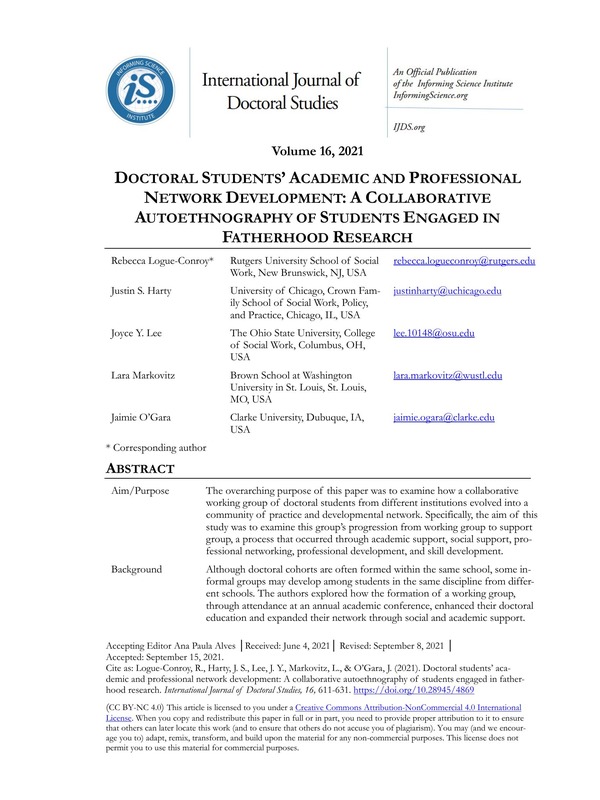
Logue-Conroy, R., Harty, J. S., Y Lee, J., Markovitz, L., & O'Gara, J. Doctoral students’ academic and professional network development: A collaborative autoethnography of students engaged in fatherhood research. International Journal of Doctoral Studies, 16, 611–631.
Aim/Purpose: The overarching purpose of this paper was to examine how a collaborative working group of doctoral students from different institutions evolved into a community of practice and developmental network. Specifically, the aim of this study was to examine this group’s progression from working group to support group, a process that occurred through academic support, social support, professional networking, professional development, and skill development. Background: Although doctoral cohorts are often formed within the same school, some informal groups may develop among students in the same discipline from different schools. The authors explored how the formation of a working group, through attendance at an annual academic conference, enhanced their doctoral education and expanded their network through social and academic support. Methodology: The participant-researchers in this study used collaborative autoethnography to collectively examine their participation in this group formed outside of their respective schools of social work. Having worked together for over a year, meeting monthly through video calls, on a discrete project, the participant-researchers embarked on this collaborative authoethnography as they discovered their transformation from working group to support group. This group of five participant-researchers examined their own feelings about their participation in the group and the consequent benefits of belonging to such a group. Contribution: This study makes an important contribution to the doctoral education literature about how doctoral students from different schools can form informal groups that serve as a key source of intra-disciplinary networking, resources, opportunities, and support. This contribution helps to further the research on what kinds of supports doctoral students need in order to remain in their programs and graduate. Findings: We found that a working group of doctoral students from different schools of social work can develop into a community that can be used for social, academic, and networking support. We discovered that relationships with peers across schools provided a supportive environment that was distinct from those formed within our schools. Joining together to achieve a common research goal encouraged members to extend content-specific support. In addition, this group found that members had the opportunity to compare experiences at their respective doctoral programs, which enhanced peer support. Recommendations for Practitioners: Special interest groups at national conferences should encourage doctoral students at different schools to form communities of practice or similar groups. This group formation may lead to opportunities for doctoral students to work on a common project (e.g., website, publication) and serve as a source of social and academic support. Recommendation for Researchers: More research is needed on whether this relationship among doctoral students within the same discipline at different schools is equally helpful among students in different disciplines. Additional research is also needed on whether communities formed during doctoral studies can promote future collaboration as students become professors or researchers. Impact on Society: The present study’s model is applicable for use in academic settings where doctoral students convene for conferences relating to research, teaching, and practice. This model can facilitate the formation of inter-university working groups among students with similar research interests, career trajectories, and life responsibilities. Such groups can enrich peer support, promote collaboration, and enhance professional development. Future Research: More research is needed on whether this kind of social support group amongst doctoral students can be sustained as the students transition into academic careers. Additional research is also needed on whether these types of informal groups work across research focus or whether it works best when students have the same research focus.
@article{logue-conroy2021, title = {Doctoral Students’ Academic and Professional Network Development: A Collaborative Autoethnography of Students Engaged in Fatherhood Research}, shorttitle = {Doctoral Students’ Academic and Professional Network Development}, author = {Logue-Conroy, Rebecca and {Harty, Justin S.} and Y Lee, Joyce and Markovitz, Lara and O'Gara, Jaimie}, date = {2021}, journaltitle = {International Journal of Doctoral Studies}, shortjournal = {Int. J. Dr. Stud.}, volume = {16}, pages = {611--631}, issn = {1556-8881, 1556-8873}, doi = {10.28945/4869}, } -
2018
Journal articles
Kim, D. H., Harty, J. S., Takahashi, L., & Voisin, D. R. The protective effects of religious beliefs on behavioral health factors among low income African American adolescents in chicago. Journal of Child and Family Studies, 27(2), 355–364.
@article{kim2018a, title = {The Protective Effects of Religious Beliefs on Behavioral Health Factors among Low Income {African American} Adolescents in Chicago}, author = {Kim, Dong Ha and {Harty, Justin S.} and Takahashi, Lois and Voisin, Dexter R.}, date = {2018}, journaltitle = {Journal of Child and Family Studies}, shortjournal = {J. Child Fam. Stud.}, volume = {27}, number = {2}, pages = {355--364}, issn = {1062-1024, 1573-2843}, doi = {10.1007/s10826-017-0891-5}, } -
2017
Journal articles
Voisin, D. R., Harty, J. S., Kim, D. H., Elsaesser, C., & Takahashi, L. M. Assessing the relationship between parental influences and wellbeing among low income African American adolescents in Chicago. Child & Youth Care Forum, 46(2), 223–242.
@article{voisin2017,
  title = {Assessing the Relationship between Parental Influences and Wellbeing among Low Income {African American} Adolescents in {Chicago}},
  author = {Voisin, Dexter R. and {Harty, Justin S.} and Kim, Dong Ha and Elsaesser, Caitlin and Takahashi, Lois M.},
  date = {2017},
  journaltitle = {Child \& Youth Care Forum},
  shortjournal = {Child Youth Care Forum},
  volume = {46},
  number = {2},
  pages = {223--242},
  issn = {1053-1890, 1573-3319},
  doi = {10.1007/s10566-016-9373-y},
}
Journal articles, in press (1)
-
2026
Journal articles, in press
Harty, J. S., & Schiele, J. H. Reevaluating Frazier’s ‘The Pathology of Race Prejudice’ from a social work perspective. Ethnic and Racial Studies.
@article{zotero-item-9048,
  title = {Reevaluating {Frazier}’s ‘{The Pathology} of {Race Prejudice}’ from a Social Work Perspective},
  author = {Harty, Justin S.} and Schiele, Jerome H.},
  date = {2026},
  journaltitle = {Ethnic and Racial Studies},
  shortjournal = {Ethn. Racial Stud.},
}
Book chapters (8)
-
2025
Book chapters
BlackDeer, A. A., & Harty, J. S. Decolonial abolitionist kinship as a liberatory praxis in the academy. In W. L. Garrett-Walker, Q. D. Alexander, J. Brant, & J. Pham (Eds.), Home(Place): Honouring, (re)membering and (re)storying the process of matriarchal worlding as kinship (pp. 215–226). Demeter Press.
@incollection{blackdeer2025a, title = {Decolonial Abolitionist Kinship as a Liberatory Praxis in the Academy}, booktitle = {Home(Place): {Honouring}, (Re)Membering and (Re)Storying the Process of Matriarchal Worlding as Kinship}, author = {BlackDeer, Autumn Asher and {Harty, Justin S.}, editor = {Garrett-Walker, Whitneé L. and Alexander, Qui D. and Brant, Jennifer and Pham, Jasmine}, date = {2025}, pages = {215--226}, publisher = {Demeter Press}, url = {https://doi.org/10.2307/jj.32384788.15}, isbn = {978-1-77258-560-5 978-1-77258-550-6}, } -
2025
Book chapters
Harty, J. S., & Courtney, M. E. United States. In Young people's transitions from care to adulthood: International research and practice. Oxford University Press.
@incollection{harty2025e, title = {United {States}}, booktitle = {Young People's Transitions from Care to Adulthood: {International} Research and Practice}, author = {Harty, Justin S.} and Courtney, Mark E.}, date = {2025}, edition = {2}, publisher = {Oxford University Press}, } -
2024
Book chapters
Harty, J. S., BlackDeer, A. A., Ocampo, M. G., & Grinnell-Davis, C. L. Abolition: The missing link in historical efforts to address racism and colonialism within the profession of social work. In C. Rasmussen, M. Kim, & D. M. Washington (Eds.), Abolition and social work: Possibilities, paradoxes, and the practice of community care (pp. 65–76). Haymarket Press.
@incollection{harty2024, title = {Abolition: {The} Missing Link in Historical Efforts to Address Racism and Colonialism within the Profession of Social Work}, booktitle = {Abolition and Social Work: {Possibilities}, Paradoxes, and the Practice of Community Care}, author = {Harty, Justin S.} and BlackDeer, Autumn Asher and Ocampo, Maria Garcia and Grinnell-Davis, Claudette L.}, editor = {Rasmussen, Cameron and Kim, Mimi and Washington, Durrell Malik}, date = {2024}, pages = {65--76}, publisher = {Haymarket Press}, url = {https://www.haymarketbooks.org/books/2226-abolition-and-social-work}, } -
2023
Book chapters
Harty, J. S. Epilogue: Looking back to move forward. In L. S. Abrams, S. E. Crewe, A. J. Dettlaff, & J. H. Williams (Eds.), Social work, white supremacy, and racial justice: Reckoning with our history, interrogating our present, and reimagining our future (pp. 781–790). Oxford University Press.
@incollection{harty2023g, title = {Epilogue: Looking Back to Move Forward}, booktitle = {Social Work, White Supremacy, and Racial Justice: {Reckoning} with Our History, Interrogating Our Present, and Reimagining Our Future}, author = {Harty, Justin S.}, editor = {Abrams, Laura S and Crewe, Sandra Edmonds and Dettlaff, Alan J and Williams, James Herbert}, date = {2023}, pages = {781--790}, publisher = {Oxford University Press}, url = {https://doi.org/10.1093/oso/9780197641422.003.0042}, } -
2023
Book chapters
Harty, J. S., & Banman, A. Engaging fathers in child welfare and foster care settings: Promoting paternal contributions to the safety, permanency, and well-being of children and families. In J. L. Bellamy, B. P. Lemmons, Q. R. Cryer-Coupet, & J. A. Shadik (Eds.), Social Work Practice with Fathers (pp. 185–205). Springer International Publishing.
@incollection{harty2023, title = {Engaging Fathers in Child Welfare and Foster Care Settings: Promoting Paternal Contributions to the Safety, Permanency, and Well-Being of Children and Families}, shorttitle = {Engaging Fathers in Child Welfare and Foster Care Settings}, booktitle = {Social {Work Practice} with {Fathers}}, author = {Harty, Justin S.} and Banman, Aaron}, editor = {Bellamy, Jennifer L. and Lemmons, Brianna P. and Cryer-Coupet, Qiana R. and Shadik, Jennifer A.}, date = {2023}, pages = {185--205}, publisher = {Springer International Publishing}, location = {Cham}, url = {https://link.springer.com/10.1007/978-3-031-13686-3_11}, isbn = {978-3-031-13685-6 978-3-031-13686-3}, } -
2021
Book chapters
Bellamy, J. L., Harty, J. S., Banman, A., & Guterman, N. B. Engaging fathers in perinatal home visiting: Early lessons from a randomized controlled study of Dads Matter-HV. In J. Pearson & J. Fagan (Eds.), New research on parenting programs for low-income fathers (pp. 58–73). Routledge.
@incollection{bellamy2021a, title = {Engaging Fathers in Perinatal Home Visiting: Early Lessons from a Randomized Controlled Study of {Dads Matter-HV}}, booktitle = {New Research on Parenting Programs for Low-Income Fathers}, author = {Bellamy, Jennifer L. and {Harty, Justin S.} and Banman, Aaron and Guterman, Neil B.}, editor = {Pearson, Jessica and Fagan, Jay}, date = {2021}, pages = {58--73}, publisher = {Routledge}, url = {https://doi.org/10.4324/9780367363444-5-5}, isbn = {978-0-367-36344-4}, } -
2021
Book chapters
Harty, J. S. Pregnant and parenting foster youth. In J. M. Geiger & L. A. Schelbe (Eds.), Handbook on child welfare practice; Research brief in Chapter 11: Special populations in child welfare practice (pp. 276–277). Springer.
@incollection{harty2021c, title = {Pregnant and Parenting Foster Youth}, booktitle = {Handbook on Child Welfare Practice; {Research} Brief in {Chapter} 11: {Special} Populations in Child Welfare Practice}, author = {Harty, Justin S.}, editor = {Geiger, Jennifer Mullins and Schelbe, Lisa Ann}, date = {2021}, pages = {276--277}, publisher = {Springer}, url = {https://doi.org/10.1007/978-3-030-73912-6_11}, } -
2021
Book chapters
Harty, J. S., & Walsh, T. B. Engaging fathers in child welfare practice. In J. M. Geiger & L. A. Schelbe (Eds.), Handbook on child welfare practice; Research brief in Chapter 6: Child and family engagement in child welfare practice (pp. 166–167). Springer.
@incollection{harty2021b,
  title = {Engaging Fathers in Child Welfare Practice},
  booktitle = {Handbook on Child Welfare Practice; {Research} Brief in {Chapter} 6: {Child} and Family Engagement in Child Welfare Practice},
  author = {Harty, Justin S.} and Walsh, Tova B},
  editor = {Geiger, Jennifer Mullins and Schelbe, Lisa Ann},
  date = {2021},
  pages = {166--167},
  publisher = {Springer},
  url = {https://doi.org/10.1007/978-3-030-73912-6_6},
}
Book chapters, in press (2)
-
2026
Book chapters, in press
BlackDeer, A. A., & Harty, J. S. Critical issues in conceptualizing race, ethnicity & indigeneity. In V. R. Winter, C. Daniel, N. E. Walls, & M. S. Spencer (Eds.), Decolonizing quantitative methods: Anti-oppressive approaches to social work research. Cambridge University Press.
@incollection{harty2026a, title = {Critical Issues in Conceptualizing Race, Ethnicity \& Indigeneity}, booktitle = {Decolonizing Quantitative Methods: {Anti}-Oppressive Approaches to Social Work Research}, author = {BlackDeer, Autumn Asher and {Harty, Justin S.}, editor = {Winter, Virginia Ramseyer and Daniel, CarolAnn and Walls, N. Eugene and Spencer, Michael S.}, date = {2026}, publisher = {Cambridge University Press}, } -
2026
Book chapters, in press
Harty, J. S., & Bellamy, J. L. Revisioning methodological approaches in prevention research through a QuantCrit framework. In V. R. Winter, C. Daniel, N. E. Walls, & M. S. Spencer (Eds.), Decolonizing quantitative methods: Anti-oppressive approaches to social work research. Cambridge University Press.
@incollection{zotero-item-9050,
  title = {Revisioning Methodological Approaches in Prevention Research through a {QuantCrit} Framework},
  booktitle = {Decolonizing Quantitative Methods: {Anti}-Oppressive Approaches to Social Work Research},
  author = {Harty, Justin S.} and Bellamy, Jennifer L.},
  editor = {Winter, Virginia Ramseyer and Daniel, CarolAnn and Walls, N. Eugene and Spencer, Michael S.},
  date = {2026},
  publisher = {Cambridge University Press},
}
Reports and briefs (9)
-
2021
Reports and briefs
Bellisle, D. J., Harty, J. S., & Letiecq, B. L. Dismantling structural racism and white nuclear family hegemony in the tax code. National Council on Family Relations.
@report{bellisle2021, title = {Dismantling Structural Racism and White Nuclear Family Hegemony in the Tax Code}, author = {Bellisle, Dylan J and {Harty, Justin S.} and Letiecq, Bethany L.}, date = {2021}, institution = {National Council on Family Relations}, url = {https://www.ncfr.org/ncfr-report/fall-2021}, } -
2020
Reports and briefs
Bellamy, J. L., Harty, J. S., Guterman, N. B., Morales-Mirque, S., Banman, A., & Combs, K. M. The engagement of fathers in home visiting services: Learning from the Dads Matter–HV Study. Fatherhood Research & Practice Network.
Methods....................................................................................................................................................................................................................................... 9 Study Design................................................................................................................................................................................................................................................... 9 Sample................................................................................................................................................................................................................................................................11 Quantitative Measures........................................................................................................................................................................................................................... 12 Quantitative Data Analysis.................................................................................................................................................................................................................. 13 Qualitative Methods................................................................................................................................................................................................................................ 14 Qualitative Data Analysis...................................................................................................................................................................................................................... 14 Results........................................................................................................................................................................................................................................ 15 Home Visitor Attitudes and Expectations............................................................................................................................................................................... 15 Father Participation in Services.......................................................................................................................................................................................................16 Mother Participation in Services.....................................................................................................................................................................................................16 Parent-Worker Relationships............................................................................................................................................................................................................16 Relationship between Clinical Content, Parent Beliefs and Expectations, Home Visitor–Parent Relationship, and Demographics............................................................................................................................................................................................................................................. 17 Worker Strategies to Engage Fathers........................................................................................................................................................................................ 17 Discussion................................................................................................................................................................................................................................. 18 Home Visitor Attitudes and Expectations...............................................................................................................................................................................18 Fathers' Participation in Home Visits...........................................................................................................................................................................................18 Parent-Worker Relationships............................................................................................................................................................................................................19 Dads Matter-HV, Parents’ Beliefs and Expectation, and Home Visitors’ Relationship with Mothers and Fathers.....................................................................................................................................................................................................................................................19 Worker Strategies to Engage Fathers....................................................................................................................................................................................... 20 Limitations...................................................................................................................................................................................................................................................... 20 Conclusions............................................................................................................................................................................................................................. 21 References............................................................................................................................................................................................................................................................22
@report{bellamy2020, title = {The Engagement of Fathers in Home Visiting Services: {Learning} from the {Dads Matter}–{HV Study}}, author = {Bellamy, Jennifer L and {Harty, Justin S.} and Guterman, Neil B and Morales-Mirque, Sandra and Banman, Aaron and Combs, Katie Massey}, date = {2020}, pages = {1--23}, institution = {Fatherhood Research \& Practice Network}, url = {https://www.frpn.org/sites/default/files/FRPN_DadsMatter_FullReport_012020_R3-1.pdf}, } -
2020
Reports and briefs
Courtney, M. E., Okpych, N. J., Harty, J. S., Feng, H., Park, S., Powers, J., Nadon, M., Ditto, D. J., & Park, K. Findings from the California Youth Transitions to Adulthood Study (CalYOUTH): Conditions of youth at age 23. Chapin Hall at the University of Chicago.
@report{courtney2020, title = {Findings from the {California Youth Transitions} to {Adulthood Study} ({CalYOUTH}): {Conditions} of Youth at Age 23}, author = {Courtney, Mark E. and Okpych, Nathanael J. and {Harty, Justin S.} and Feng, Huiling and Park, Sunggeun and Powers, Jenna and Nadon, Melanie and Ditto, Dale J. and Park, Keunhye}, date = {2020}, institution = {Chapin Hall at the University of Chicago}, url = {https://www.chapinhall.org/wp-content/uploads/CY_YT_RE1020.pdf}, } -
2020
Reports and briefs
Feng, H., Harty, J. S., Okpych, N. J., & Courtney, M. E. Memo from CalYOUTH: Predictors of homelessness at age 21. Chapin Hall at the University of Chicago.
@report{feng2020, title = {Memo from {CalYOUTH}: {Predictors} of Homelessness at Age 21}, author = {Feng, Huiling and {Harty, Justin S.} and Okpych, Nathanael J and Courtney, Mark E}, date = {2020}, institution = {Chapin Hall at the University of Chicago}, url = {https://www.chapinhall.org/wp-content/uploads/PDF/CY_PH_IB0520.pdf}, } -
2019
Reports and briefs
Courtney, M. E., Park, S., Harty, J. S., & Feng, H. Memo from CalYOUTH: Relationships between youth and caseworker perceptions of the service context and foster youth outcomes. Chapin Hall at the University of Chicago.
@report{courtney2019a, title = {Memo from {CalYOUTH}: Relationships between Youth and Caseworker Perceptions of the Service Context and Foster Youth Outcomes}, author = {Courtney, Mark E and Park, Sunggeun and {Harty, Justin S.} and Feng, Huiling}, date = {2019}, institution = {Chapin Hall at the University of Chicago}, url = {https://www.chapinhall.org/wp-content/uploads/Service-context-and-foster-youth-outcomes.pdf}, } -
2018
Reports and briefs
Courtney, M. E., Okpych, N. J., Park, K., Harty, J. S., Feng, H., Torres-García, A., & Sayed, S. Findings from the California Youth Transitions to Adulthood Study (CalYOUTH): Conditions of youth at age 21. Chapin Hall at the University of Chicago.
@report{courtney2018a, title = {Findings from the {California Youth Transitions} to {Adulthood Study} ({CalYOUTH}): {Conditions} of Youth at Age 21}, author = {Courtney, Mark E. and Okpych, Nathanael J. and Park, Keunhye and {Harty, Justin S.} and Feng, Huiling and Torres-García, Adrianna and Sayed, Samiya}, date = {2018}, institution = {Chapin Hall at the University of Chicago}, url = {https://www.chapinhall.org/wp-content/uploads/CY_YT_RE0518_1.pdf}, } -
2017
Reports and briefs
Courtney, M. E., Harty, J. S., Kindle, B., Dennis, K., Okpych, N. J., & Garcia, A. T. Findings from the California Youth Transitions to Adulthood Study (CalYOUTH): Conditions of youth at age 19: Los Angeles County Report. Chapin Hall at the University of Chicago.
@report{courtney2017d, title = {Findings from the {California Youth Transitions} to {Adulthood Study} ({CalYOUTH}): {Conditions} of Youth at Age 19: {Los Angeles County Report}}, author = {Courtney, Mark E. and {Harty, Justin S.} and Kindle, Brittani and Dennis, Kristin and Okpych, Nathanael J. and Garcia, A T}, date = {2017}, institution = {Chapin Hall at the University of Chicago}, url = {https://www.chapinhall.org/wp-content/uploads/CY_YT_RE0517.pdf}, } -
2016
Reports and briefs
Courtney, M. E., Okpych, N. J., Charles, P., Mikell, D., Stevenson, B., Park, K., Kindle, B., Harty, J. S., & Feng, H. Findings from the California Youth Transitions to Adulthood Study (CalYOUTH): Conditions of youth at age 19. Chapin Hall at the University of Chicago.
@report{courtney2016, title = {Findings from the {California Youth Transitions} to {Adulthood Study} ({CalYOUTH}): {Conditions} of Youth at Age 19}, author = {Courtney, Mark E. and Okpych, Nathanael J. and Charles, Pajarita and Mikell, Dominique and Stevenson, Brooke and Park, Keunhye and Kindle, Brittani and {Harty, Justin S.} and Feng, Huiling}, date = {2016}, institution = {Chapin Hall at the University of Chicago}, url = {https://www.chapinhall.org/wp-content/uploads/CY_YT_RE0516.pdf}, } -
2016
Reports and briefs
Courtney, M. E., Okpych, N. J., Mikell, D., Stevenson, B., Park, K., Harty, J. S., Feng, H., & Kindle, B. CalYOUTH survey of young adults' child welfare workers. Chapin Hall at the University of Chicago.
@report{courtney2016a,
  title = {{CalYOUTH} Survey of Young Adults' Child Welfare Workers},
  author = {Courtney, Mark E and Okpych, Nathanael J and Mikell, Dominique and Stevenson, Brooke and Park, Keunhye and {Harty, Justin S.} and Feng, Huiling and Kindle, Brittani},
  date = {2016},
  institution = {Chapin Hall at the University of Chicago},
  url = {https://www.chapinhall.org/wp-content/uploads/CY_CW_RE0516_1.pdf},
}
Book reviews (1)
-
2021
Book reviews

Harty, J. S. Lost and found: Young fathers in the age of unwed parenthood. By Paul Florsheim and David Moore. New York: Oxford University Press, 2020. Pp. 432. \$29.95 (cloth) [Book review]. Social Service Review, 95(2), 358–364.
@article{harty2021d,
  title = {Lost and Found: {Young} Fathers in the Age of Unwed Parenthood. {By Paul Florsheim} and {David Moore}. {New York}: {Oxford University Press}, 2020. {Pp}. 432. \$29.95 (Cloth) [{Book} Review].},
  shorttitle = {\mkbibemph{Lost and }{\mkbibemph{Found}},
  author = {Harty, Justin S.},
  date = {2021},
  journaltitle = {Social Service Review},
  shortjournal = {Soc. Serv. Rev.},
  volume = {95},
  number = {2},
  pages = {358--364},
  issn = {0037-7961, 1537-5404},
  doi = {10.1086/714553},
}